Showing posts with label history. Show all posts

Wednesday, July 4, 2012

What Once Was; The Story of a Danish Bicycle Manufacturer


Denmark has always been a cycling country – thousands upon thousands of people commute to work on their bikes everyday and Denmark is always mentioned as a pioneer country in the field of bicycling. Nonetheless, most people are these days riding around on bicycles manufactured in various countries in the Far East, which I think is a bit sad considering the rich (and important!) bicycle heritage of our small country. I hope this doesn't come off, as being the usual pathetic nonsense cliché of “things aren't as good, as they were in the good old days”, as there is still a lot of quality bikes being manufactured in other parts of the world. Instead I would rather use this post to tell a little story about a Danish bicycle manufacturer. I can't deny that there will be a pinch of romanticizing and nostalgia, though.

Nordisk Cyclefabrik A/S (notice the different spelling and even pronunciation) was probably established in 1895 by one H.P. Hansen. I'm not quite sure about the last part, as the former Danish time trial world champion Henry-Peter Hansen, who later became affiliated with the company, wasn't born before 1902. So either they shared the name or there has been some misunderstandings over the years. I invite you to decide for yourself. After moving the factory around Sjælland the first few years, the manufacturing was moved to the free port of Copenhagen. The free port was a place filled with different factories and a few other bicycle companies also had factories there.


What was different about Nordisk Cyclefabrik was the bicycle they made, that didn't have any chain like most other bicycles did. Rather they made a bike that was shaft-driven (“kardantræk” in Danish) with the name “La Danoise”. The type of bike became quite popular at the time and was even exported to other countries; even the Netherlands. Of course they also made normal chain-driven bikes and around the 1930's they introduced the Danish people to the Swedish Crescent, that still exists today. In these years the factory also made a bike, that is still known today as the “sofacykel”. It was a bike with a complete seat rather than just a saddle and the positioning of the rider was much more laid back; not far from the cruisers seen today. I'm not sure, whether or not it was that big a success though. It was meant to be more comfortable, but it turned out to be a quite awkward position to ride in.


In 1933, the company moved to Vanløse west of Copenhagen, where Henry-Peter Hansen had built a factory in a functionalist style typical of the period. From this period it is quite hard to find information about the factory and what happened. What I do know is that in the 1950's the factory was eventually sold to a Swedish company called Nymanbolagen, that already produced brands like the aforementioned Crescent. The old factory building in Vanløse was sold to the government in 1969 and it now houses a school of education, but what happened between these years I haven't been able to stumble upon anywhere.


I hope this little story will be of interest to some people and that we some day can see bicycles being manufactured for the people in Denmark again. Of course there are still Danish bicycle manufacturers, but to my knowledge it is mostly expensive, custom-built luxury bikes like Sögreni and Cykelmageren and cargo bikes like the Christiania bike and Nihola. I would love to see everyday bikes being manufactured in Denmark again and not just assembled.

All words by Lars Engelbrecht 

Sunday, November 6, 2011

Victorinox Pocket Knife


This pocket knife is one of the more recent additions to my collection of knives. It was handed down to my by my sister, who didn't have a use for it. I actually don't know, why it was given to her, but it used to belong to my grandfather on my mother's side. My mother's father, Thorvald, was a sailor. He grew up on a farm, but left home to go sailing and did so for quite some years.
I don't remember much about him, except he had the biggest hands I have ever seen - at least from a child's perspective, but it has been confirmed by my family. And I remember him having quite a lot of tattoos, which I could stare at for hours. You have to keep in mind, that this was in the days, when tattoos weren't something, that you would seen on everybody, as you do nowadays.

This knife, is mostly referred to as a "Swiss Army Knife", because it was supplied to the Swiss army. It is in fact made by the company, Victorinox, which makes these knives and has done so for a long time. This knife is very famous, and I'm sure, most of you already know, that this is a great knife with a myriad of great tools and purposes. I'm really happy with mine, although I would of course like the "Champion" model, which is the one, that got picked for the Permanent Design Collection on the Museum of Modern Art in New York. Mine will suffice however, and I just need to get it sharpened and cleaned.


A fun fact about the name Victorinox, is that the name is a contraction of the name Victoria and the French term for Stainless steel, "acier inoxybable". Victoria was the founder's mother's name and in her honour he named the company after her, when she passed away. This I find very beautiful.

Thursday, September 29, 2011

Henriques & Løvengreen

Sometimes you hear the phrase, they don't make 'em like this anymore. Actually a rather tiresome phrase, however there is some truth to it sometimes - or probably quite often.


In the case of this henley - by a now long-gone company called Henriques & Løvengreen - it is true. It is a product so well-made, that it becomes almost a piece of industrial art.

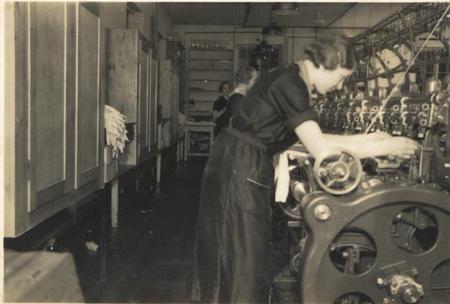
This type of henley was quite common among working men. But I have found other examples of it, and none of them has been as nice and as well-made as this one. It is made of a wool-cotton blend, that has been rather tightly woven on loopwheel machines - hence no side seam. The fabric offers very little stretch, which you might expect and it feels like the reverse has been combed for softness. The colour is so amazing with the melange and irregularities in the weave. 
I'm guessing that this is from the 30s to 50s, but I can't be entirely sure. If somebody knows, please tell me.


As you can see, there is some discolouration from storage. Other than that it is pristine, deadstock condition. I'm sure that the discolouration will go away if properly washed or dry cleaned.


The difference in knit on the cuffs is a great detail.


The insert in the pit is a typical detail of undergarments from back in the day.


Flawless construction and execution


This tag is so great


The stitching is perfect


All edges have been covered in this grosgrain-ish fabric


There is even a satin backing to reinforce the buttonholes and insure, that they keep their shape


In case you hadn't noticed the buttons are genuine mother of pearl buttons


Now this post wouldn't be anything without the video, that I found. The video shows the production at the Henriques&Løvengreen factory and it was made in 1910.

I can't embed it, but you can watch it here - remember to go Full screen.

One Month of Denim - Day 29

One Month of Denim is coming to an end. I was thinking about writing about the big three - Levi's, Wrangler and Lee, but you probably already know a lot about them, and if you don't it is fairly easy finding some trustworthy information elsewhere. Furthermore I figured giving you some Danish denim history might expand your horizon a bit.

Today's post may bear a resemblance to yesterday's post, however I figured it would still be of some interest. This FE Engel jacket I found recently. It is probably from the 50's or the 60's like the other jacket, but this is probably more recent. In case you are wondering, this jacket is slightly too small for me, so I'm sending off to a new, good friend of mine, who I think will appreciate it.

F. Engel was founded by Carl J. Engel Senior in 1927 in the Southern part of Denmark. Today the business is still family owned, however production has moved to Lithuania, just like it is the case with a lot of Danish makers.

Back in the days everything was cut and sewn in Denmark, often using what is known as "Bull Denim" from Erwin Mills in the US. For your information; Erwin Mills were the first to use Sanforisation, as mentioned in a previous post. Bull Denim is a rather heavy denim weave with the typical twill construction, except it is later piece dyed.
I don't think F. Engel continued using denim from Erwin Mills, I suspect, that they - along with other workwear makers - started using denim, that was woven locally on Grenaa Damvæveri, which closed it doors 10 years ago.

On to the jacket.


The construction is pretty basic. Short jacet with two front pockets.


Big front pockets with brass snap buttons. The pockets are internally reinforced.


As you can see all seams are felled and triple stitched. The two top buttons are snap buttons, whereas the rest are regular buttons.


Selvage runs down the placket and the buttons are hidden. Pretty crude construction.


Concealed button.


The waist is elasticized, which gives a more modern and in my opinion a better fit.


The denim is has a purple hue or cast.


Furthermore it is quite hairy and slubby, which is a sign of using a cotton with a short stable length. This is normally a sign of a poor quality, but it ads to the character in my opinion. Purists are sometimes going for this look - For instance Roy Slaper made a pair of contest jeans for Superfuture, which was made of a special fabric from Cone Mills, that was very hairy and slubby.


It even has some mill flaws, which again ads to the character.


The American inspiration becomes quite obvious, when you see, that the snaps are made by Scovill, which also supplied many of the big American jeans and workwear companies - including Levi's.


The tag is quite cute. You don't see anything like that anymore.

"When Harris Tweed Isn’t" by James Taylor

There are many pleasures associated with buying vintage clothing. There’s thrill of the hunt as you enter a new thrift store or trade show, wondering what treasures (if any) await among the musty drabness, the tingle of excitement when a ‘phone call or email comes in from someone who knows I collect vintage clothing, asking if I’d like to look at the stuff Grandad left in his attic before it heads off to the thrift store or landfill. There’s the pleasure in finding a long-unloved tweed overcoat, and spending time making the minor repairs to bring it back to use, keeping someone warm. And there’s the speculative pleasure involved in wondering how something got where it did—I still have no idea how that mint-condition chocolate-brown Poole topcoat ended up in the back of a Church thrift store in small town Ohio. And even if something is beyond rescue—a much-stained 1960s sports jacket in bleeding Madras, or a moth-eaten dinner jacket, custom made in 1956—there’s still the simple pleasure of imagining what events these clothes might have been worn at, and what manner of man had them made.
And these speculative and avaricious pleasures are joined by another type of pleasure entirely—the pleasure of the education that a mysterious label can sometimes bring.
   
In my own case this started with the label on a Harris tweed jacket. If you’re reading this blog you’ll probably be familiar with both Harris tweed and its classic trademark “Orb” emblem, which looks like this:


But in one jacket I found the label looked like this:


This was weird. This was clearly marked as Harris tweed, marked as handwoven, and came from the right area of Scotland. But it wasn’t an Orb. It was a Shield. And the name of the company behind the trademark was weird, too—The Independent Harris Tweed Producers, not the Harris Tweed Authority.
What’s going on? Is this Harris Tweed, or not?

A hint to the answer came from a 1958 edition of The Glasgow Heraldwhich reported that a newly-formed company, The Independent Harris Tweed Producers, were challenging the Harris Tweed Authority’s monopoly on calling their cloth Harris tweed. Why? Because there was a strong demand for Harris tweed in the American market, and the IHTP wanted in. And, yes, you can guess what was driving the demand then—not just post-war American prosperity, but the increasingly popular (then as now) Ivy League look, in which Harris tweed was a mainstay!
There were differences between the Shield tweed of the IHTP and the orb tweed of the HTA. The latter was only from Scottish wool, while the newcomers used wool from elsewhere the latter was spun, dyed, and finished in the Outer Hebrides only, whereas the newcomers would spin, finish, and dye anywhere in Scotland, and the Orb tweed was to be spun in crofters’ own homes, whereas the Shield tweed could be factory-made.
So, what happened? Lawsuits, filed by both sides--in 1961 by the Shields and 1962 by the Orbs. (Clearly, America was influencing more than just tweed production!)

And what happened? Well, take a look around your closet—do you see any Shield labels there, and, if you do, are they recent? The case went to the Edinburgh High Court, and was decided against the Shield faction, with Lord Hunter holding that for a cloth to be Harris Tweed it had to conform to the definition of the Board of Trade, namely that for a cloth to be Harris Tweed it must be  “a tweed, hand spun, hand woven and finished by hand in the Outer Hebrides, with ‘Made in Harris’ or ‘Made in Lewis’ or ‘Made in Uist’ etc. added as appropriate’.” The Shields’ tweed didn’t meet this definition, and so was not Harris Tweed….. And hence no more Shield Harris Tweed labels would legally be produced.

So, if, while searching through vintage tweeds, you find something labeled Harris tweed with a Shield label, rather than an Orb, you’ve found a rare relic of a almost-forgotten but very heated dispute concerning the real nature of this canonical fabric.

Sometimes a cigar is just a cigar. And sometimes Harris Tweed isn’t! 

Wednesday, September 28, 2011

One Month of Denim - Day 28


Danish denim history is hardly worth mentioning, if you want 5 pocket jeans. But if you are into workwear history, I think Danish denim history is very interesting.  Two of the biggest makers of workwear in Denmark, F Engel and Kansas, were both founded by men, who had been to the US and seen how well denim served the labourers.

Over the years I have found several interesting workwear-related denim garments in thrift stores in Denmark. I have passed on many and many I have passed on to friends, but I have never found anything for myself.

It's not unlikely, that Kansas will be covered at some other point, if I find something interesting from them and tomorrow I'll probably also be writing about Danish denim history - showcasing denim workwear from F. Engel. But today we will be looking at a denim coat from EK, that I found and passed on to my good friend Rasmus, who both contributes with a lot of photos for AtD and occasionally writes a post.

Now on to the jacket.


As you see the model is a pretty standard chore coat, however the bottom of the front pockets are lined. If I were to determine the age of it, I would be guessing, that it is from the 50's or the 60's. Other than that I'm guessing that it was made in Denmark, using fabric that was also woven in Denmark in the mills of Grenaa Dampvæveri, which closed its doors 10 years ago. I have no information on the company EK.


With nice brass buttons and keyhole buttonholes.


The denim is selvage (it runs down both plackets) and it is quite slubby or it has some irregularities. The cast is greyish light blue. As you can see all seams are felled and triple stitched. Lastly it has been hemmed using chainstitch.


Notice the selvage detail on the locker loop. 


The pockets have all been bartacked with a contrasting red thread and this particular jacket has a very nicely made embroidery that says BD


But what really makes this jacket jacket stand out and makes it very special, is the interfacing or backing of the embroidery. This is made by old news papers or what I'm assuming is news paper. You are able to make out actual words on the backing, which is really funny. I have never seen embroidery made like this. In order to fully appreciate this jacket, you have to know about this great, little feature. As you know, God is in the detail.

If you like workwear, I can't recommend Mono's Workwear magazines/books enough. Although all text is in Japanese, you can just browse the wonderful images.

More importantly if you have any stories, info or details on the Danish garment industry, please do share them with me - either in the comment section or via e-mail.

Saturday, September 24, 2011

One Month of Denim - Day 24


As always my weekends are kind of busy, so again I find myself with very little time to write about denim. So today you will have to settle with a link to a visit to the Cone Mills White Oak plant in North Carolina. This visit was done by Mr. Denim - Paul Trynka.

Cone Mills was one of the original suppliers to denim - besides Amoskeag, which folded many years ago - and they are also the supplier of many other brands. Cone Mills denim is probably not the most interesting choice of denim, although their technical department have done some amazing fabrics like the "Tweed Denim", that the American brand, Left Field used for a very limited run of jeans. I helped a friend of mine get hold of a pair and I can truly testify, that they are very unique and very beautiful. What you do get, when you buy Cone Mills denim is a very strong, hard wearing and very reliable fabric. So it is obviously one of my favourite fabric, which is also why that I decided on buying Cone Mills denim, when I acquired some denim. Other than that the denim is still mainly woven in the US and they also offer some other fabrics such as indigo dyed selvage canvas and some pretty rad cotton duck.


For the article - GO HERE!

Saturday, September 10, 2011

One Month of Denim - Day 10


There are many ways to classify or differentiate denim. One of the most important things you can talk about are shrink to fit versus sanforized. I'll not be discussing, if one fades better than the other, or if one is better than the other in general. Again, I would like to say that buying jeans is personal. You have to figure out, what works for you and what you appreciate. Before writing about the two, I would like to correct a common mistake, the difference is not between raw and sanforized. Sanforized can be just as raw as shrink to fit denim.

In the old days all cotton materials -including denim - would continue to shrink after the first couple of washes. They were shrink to fit so to speak. The cotton was untreated, which made the cotton fibers constrict after washing. Therefore the general rule was that the fabric would shrink 10%, meaning you would probably have to go 2" up in the waist and 3" in the length, when buying jeans.

Sanforization is a process to treat the cotton fabric, that was invented by Sanford L. Cluett in the late 1920's. The process was first used by Erwin Mills in the 1930's to make denim for workwear. Shortly hereafter many companies started using the sanforization process and you will often see it advertised on old clothing when the tag says sanforized or sanfor-treated. Many denim companies started using the sanforization process because it could reduce overall shrinkage to about 3%, which meant you didn't have to take shrinking into consideration, thus allowing the consumer to buy the exact size. Levi's however remained true to the shrink to fit denim until the 1970's - and they still make an shrink to fit 501 model in their main assortment (indicated by the XX after 501), plus most of the jeans in the LVC range are made of shrink to fit denim (with the exception of the 505 - and jeans from the Orange Tab range).

Nowadays the denim purists demand shrink to fit denim and there are many rituals connected to it. There are millions of ways to soak your jeans. Some soak them in the sea, some in a bucket of water, some wear them in the tub and the list goes on. Some people prefer to wear their jeans without ever washing them, but that is for the extremists, although recent studies show no health risks concerning the no-wash method.

Monday, September 5, 2011

One Month of Denim - Day 5


When Jacob Davis contacted Levi Strauss regarding acquiring a patent for his new invention he didn't invent jeans. His invention was merely, that he had reinforced a pair of pants with copper rivets. This of course made a huge difference for the common working man, who stuffed the pockets of his pants with rocks and what not to the point of actually breaking the pockets. The demand for riveted pants grew and grew and Levi Strauss with a proposition of a partnership and the rest is what we say, history. The birth of blue jeans or waist dungarees, as they were called back then, was a reality.

Up until 1937 the rivets on all stress points were all exposed. This caused for a lot of distress among cowboys and housewives alike. The rivets would simply scratch the surface of the saddles, as well as the living room furniture. This led to another invention, the hidden rivet.


The hidden rivet on the back pocket was finally replaced by a simple bar tack in the 1960's. Bar tacking is cheaper, less labour intensive and finally the hidden rivet solution was only temporary, as the rivet would wear through the protective layers of denim, and scratch saddles and chairs alike.

Thursday, September 1, 2011

One Month of Denim - Day 1

This might be a huge project, but I figured that I would make September a month of denim. Therefore I intend to make 1 post a day on the subject of denim and I will be doing it in a random order. Some posts will of course be longer than others, as I have more time on some days. This is an introduction to the subject of denim, but I hope there will also be some for the denim connoisseur.
I'm mainly doing this because the denim culture in Denmark is pretty weak and hopefully this will inspire some Danes to dig deeper into denim history and culture.


To hit things off I would like to recommend some reading on the subject of denim.


Paul Trynka has written a great little book called "From Cowboys to Catwalks", which is one of the best introductions to denim if you know some, or very little. And by that I don't mean that you won't be referring to it after a while because you probably will. It should also be mentioned that Paul Trynka is very easy to get hold of, if you have any denim related questions, as he is a very active and most helpful user on the two big fashion fora - Superfuture and Styleforum. You'll most likely find him in the threads about Levi's Vintage Clothing (LVC for people in the know).
It should also be said that Superfuture is a great source for information, as there are many people who has a genuine interest and a lot of knowledge, but you have to remain sceptic.


The denim collector and denim hunter, Michael Harris, has written a great and extremely inspiring book on pre 1900 denim called "Jeans of the Old West". Though the subject may be a bit niche, it gives you a totally different aspect to wearing denim. Michael has been hunting denim in the Arizona desert for a long time and he has been trying to recreate the history of the old denim companies together with his wife. Levi's weren't the only company making dungarees and the book covers some of the forgotten companies, but it also focuses on Levi's and the book tries to put together the puzzle that is Levi's pre 1906, when the company was hit by a fire after a big earthquake. Michael Harris has since been working together with the Rising Sun company to create a beautiful pair of jeans that were based on his finds.


David Little wrote a book called "Vintage Denim" back in the 90's. The book is quite good and can also be used as an introduction to the subject. At some point it was an collector's item of sorts, but you can sometimes find it relatively cheap on eBay.


If you want more material on denim, you need to buy expensive Japanese Magazines (or rather books) like Lightning magazine, Mono or Free & Easy. All have fortunately been getting a bigger distribution lately - check Sivletto and Superdenim for instance.


Hopefully I'll be able to make similar months on different subjects. But let's see how this goes first, as I feel this is a rather big task.