Showing posts with label copenhagen. Show all posts

Monday, December 10, 2012

On the Topic of Notebooks


I've always been amused by people, who paid a lot of money for Moleskine notebooks. Not because they're necessarily terrible, but in their marketing campaign, I remember that they gave the impression that a lot of famous artists and writers used their notebooks. But if you looked a bit closer, it was all quotes from the artists and writers saying that they couldn't live without their notebooks - not their Moleskine notebooks. I hardly think, they would pay the costs of a Moleskine.

That being said I'm one of the pretentious guys, that carries a notebook around to take notes, write down grocery lists and draw naughty drawings of naked women. I mostly use Field Notes and Rite in the Rain. And both of them has performed very well, and while I like the fact that you can write in the rain with the RITR notebook, I'm just so infatuated with the Futura font, that I prefer the Field Notes.

Lately I've been looking for alternatives - not because I actually need any, but because I was wondering if there were any made in Denmark (I didn't come across any, but I did find a Danish link) or at least in Europe. And of course you're always hoping for something perfect. As in just that really, really perfect thing (It never happens)

But I did come across a really nice notebook, which is made in France by a company called Calepino. And it was quite refreshing seeing that they had a site in English, which is something the French always seem to miss, and they also look very nice.


If you're still reading and remember that I mentioned a Danish link: The creator of Calepino, Fabrice Richard, mentioned in an interview for the shop La Belle Échoppe that he lived in Copenhagen for a while and that he was greatly inspired by the Danish design philosophy when he started the company. La Belle Échoppe is an amazing store by the way with a perfect concept that I've been meaning to write about for a long time (My notes are terribly messy and mostly unreadable)
Fabrice also mentions that he is doing custom orders, which could be totally amazing and something I would like to look into at some point. I think a slightly larger notebook would be perfect - especially if you like to draw and design stuff. You just need more space sometimes.

The other great option I found was the company Word. They make notebooks in the US. They have a great system for keeping your notes in order, which is great and they offer their notebooks with a camo cover, which is gorgeous.


The use of the Swedish M/90 camouflage is without a doubt my favourite.


If I come across other great options, I'll make sure to share them.

Tuesday, November 20, 2012

Dehen 1920 - Varsity Cardigan

Although I would probably go for a varsity cardigan from Centralia Knitting Mills - Or Skookum as it's also known - because I already own a varsity cardigan from them, and it has performed very well. Very well being an obvious understatement as the sweater is one hell of a sweater with an incredible heft and fit.


However the varsity cardigan that I have is purple with yellow stripes on the sleeves, which sounds a bit worse than it is. I still find it very wearable. But when I walked into the store Brund on my most recent trip to Copenhagen and saw this cardigan from Dehen 1920, I was thoroughly impressed by the quality and fit. It was on par with my Skookum, but the colours were definitely more wearable.


This sweater features a very heavy four end jersey knit and it's made of 100% worsted wool (which basically means it can double as a jacket). Other than that it features some really nice corozo nut buttons and as mentioned a hefty quality that you just don't get much nowadays.


I had my doubts about this company. These days a lot of old, defunct companies are being revamped and some of them aren't that impressive, when it comes down to their products and not just being nostalgic about a long and glorious history. But Dehen knows a thing or two about making a good, solid cardigan and varsity jacket that is for sure.

Wednesday, July 4, 2012

What Once Was; The Story of a Danish Bicycle Manufacturer


Denmark has always been a cycling country – thousands upon thousands of people commute to work on their bikes everyday and Denmark is always mentioned as a pioneer country in the field of bicycling. Nonetheless, most people are these days riding around on bicycles manufactured in various countries in the Far East, which I think is a bit sad considering the rich (and important!) bicycle heritage of our small country. I hope this doesn't come off, as being the usual pathetic nonsense cliché of “things aren't as good, as they were in the good old days”, as there is still a lot of quality bikes being manufactured in other parts of the world. Instead I would rather use this post to tell a little story about a Danish bicycle manufacturer. I can't deny that there will be a pinch of romanticizing and nostalgia, though.

Nordisk Cyclefabrik A/S (notice the different spelling and even pronunciation) was probably established in 1895 by one H.P. Hansen. I'm not quite sure about the last part, as the former Danish time trial world champion Henry-Peter Hansen, who later became affiliated with the company, wasn't born before 1902. So either they shared the name or there has been some misunderstandings over the years. I invite you to decide for yourself. After moving the factory around Sjælland the first few years, the manufacturing was moved to the free port of Copenhagen. The free port was a place filled with different factories and a few other bicycle companies also had factories there.


What was different about Nordisk Cyclefabrik was the bicycle they made, that didn't have any chain like most other bicycles did. Rather they made a bike that was shaft-driven (“kardantræk” in Danish) with the name “La Danoise”. The type of bike became quite popular at the time and was even exported to other countries; even the Netherlands. Of course they also made normal chain-driven bikes and around the 1930's they introduced the Danish people to the Swedish Crescent, that still exists today. In these years the factory also made a bike, that is still known today as the “sofacykel”. It was a bike with a complete seat rather than just a saddle and the positioning of the rider was much more laid back; not far from the cruisers seen today. I'm not sure, whether or not it was that big a success though. It was meant to be more comfortable, but it turned out to be a quite awkward position to ride in.


In 1933, the company moved to Vanløse west of Copenhagen, where Henry-Peter Hansen had built a factory in a functionalist style typical of the period. From this period it is quite hard to find information about the factory and what happened. What I do know is that in the 1950's the factory was eventually sold to a Swedish company called Nymanbolagen, that already produced brands like the aforementioned Crescent. The old factory building in Vanløse was sold to the government in 1969 and it now houses a school of education, but what happened between these years I haven't been able to stumble upon anywhere.


I hope this little story will be of interest to some people and that we some day can see bicycles being manufactured for the people in Denmark again. Of course there are still Danish bicycle manufacturers, but to my knowledge it is mostly expensive, custom-built luxury bikes like Sögreni and Cykelmageren and cargo bikes like the Christiania bike and Nihola. I would love to see everyday bikes being manufactured in Denmark again and not just assembled.

All words by Lars Engelbrecht 

Sunday, January 15, 2012

Hansen - SS12 Images

I saw these pictures some time ago, when we visited the lovely people over at Hansen (remember?), and I couldn't help feeling an urge to go to Sweden in the summertime - actually I just wanted the seasons to change into summer all together. But spending the summer in Sweden wouldn't be too bad either. Which reminds me, I should probably finally spend a vacation in Sweden, as I really want to visit the tannery in Tärnsjö as well.

I won't say much about these pictures other than I think, that the men in Åse's family (because that is exactly what they are - real men) look very handsome and the pictures are very nice as well. The clothes look amazing too of course.

I really look forward to spending some time with our friends at Hansen and hopefully we can cover some of their interesting garments yet again in another post.


Thursday, September 29, 2011

Henriques & Løvengreen

Sometimes you hear the phrase, they don't make 'em like this anymore. Actually a rather tiresome phrase, however there is some truth to it sometimes - or probably quite often.


In the case of this henley - by a now long-gone company called Henriques & Løvengreen - it is true. It is a product so well-made, that it becomes almost a piece of industrial art.

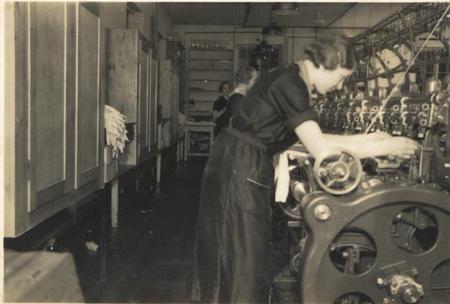
This type of henley was quite common among working men. But I have found other examples of it, and none of them has been as nice and as well-made as this one. It is made of a wool-cotton blend, that has been rather tightly woven on loopwheel machines - hence no side seam. The fabric offers very little stretch, which you might expect and it feels like the reverse has been combed for softness. The colour is so amazing with the melange and irregularities in the weave. 
I'm guessing that this is from the 30s to 50s, but I can't be entirely sure. If somebody knows, please tell me.


As you can see, there is some discolouration from storage. Other than that it is pristine, deadstock condition. I'm sure that the discolouration will go away if properly washed or dry cleaned.


The difference in knit on the cuffs is a great detail.


The insert in the pit is a typical detail of undergarments from back in the day.


Flawless construction and execution


This tag is so great


The stitching is perfect


All edges have been covered in this grosgrain-ish fabric


There is even a satin backing to reinforce the buttonholes and insure, that they keep their shape


In case you hadn't noticed the buttons are genuine mother of pearl buttons


Now this post wouldn't be anything without the video, that I found. The video shows the production at the Henriques&Løvengreen factory and it was made in 1910.

I can't embed it, but you can watch it here - remember to go Full screen.